
Getting around Los Angeles is easier than ever, thanks to the growing Los Angeles Metro network. With extensive rail lines and bus routes connecting cultural attractions, beaches, and major neighborhoods, visitors can explore the city with greater convenience and flexibility.
The LA Metro system serves nearly 10 million residents, commuters, and visitors across a sprawling 1,400-square-mile area. This vast web of 100-plus bus routes and six rail lines is the third-largest transportation system in the United States. Recent investments have fueled significant expansion, making it easier than ever to navigate L.A. without a car.
Whether you're a 2026 World Cup visitor headed to SoFi Stadium for one of L.A.'s eight matches or simply a curious traveler looking to explore the city like a local, here's everything you need to know to navigate Los Angeles using Metro.
How LA Metro Works
LA Metro operates two main types of service: rail and bus. Use Metro's Trip Planner tool or apps like Google Maps to check schedules and plan out your specific route before you go.
- Metro Rail is the fastest way to travel between major hubs and attractions. It’s made up of six lines (two of which are underground subways).
- Metro Bus expands access to neighborhoods and local destinations across Los Angeles County, with 117 routes reaching neighborhoods and destinations not served by train.
How to Pay
To ride any Metro service, you'll need a TAP card, the system's reloadable transit pass. You can purchase one at any Metro Rail station vending machine for $2, then load it with a single fare, a day pass, or a weekly pass, depending on your needs. Alternately, add a TAP card to the mobile app or your Apple Wallet for contactless payment.
A single fare is $1.75, and an unlimited day pass runs $5. For visitors planning to use Metro more than a couple of times in a day, the day pass is almost always the better value. Riders receive two hours of free transfers to other Metro lines with each ride on a TAP card.
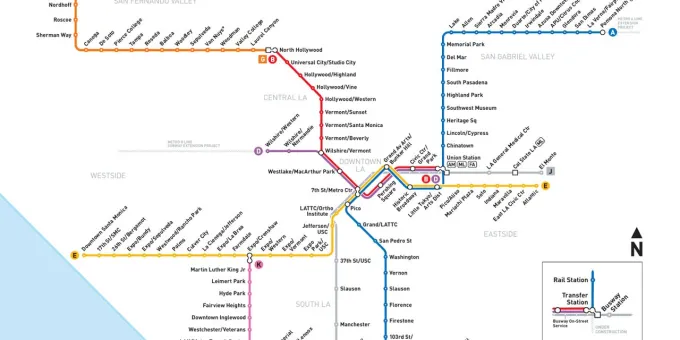
Metro Rail Lines Explained
Metro Rail serves as the primary backbone for getting around, with buses filling in the gaps for shorter, more localized trips.
Rail lines:
- A Line (Blue): Long Beach to Azusa, with a key connection near LAX
- B Line (Red): Downtown L.A. to North Hollywood, running through Hollywood
- C Line (Green): Redondo Beach to Norwalk
- D Line (Purple): Downtown L.A. to Westwood/UCLA
- E Line (Gold): Downtown L.A. to Santa Monica
- K Line (Pink): Inglewood to Expo/Crenshaw station
How to Get From LAX to Los Angeles by Metro
Getting from Los Angeles International Airport (LAX) to the city by public transit is easier than ever, thanks to a new transit center that opened to the public in 2025. The travel hub provides a direct connection between the airport and the Metro Rail network, along with local and regional bus lines. Currently, a free shuttle connects the airport terminals to the transit center. However, later in 2026, a 24-hour automated people mover will replace the shuttle entirely.
From the transit center, travelers can board the A Line or K Line to reach destinations across the city. Key connections include Downtown L.A., Hollywood, Culver City, Santa Monica, and Long Beach—all without ever stepping into a car.
A note on luggage: Metro is perfectly manageable with a carry-on or a standard rolling suitcase. However, during rush hour, trains can get crowded, so keep this in mind if you're arriving with oversized luggage or multiple bags.
How to Get to SoFi Stadium by Metro
Getting to SoFi Stadium (aka Los Angeles Stadium during the soccer tournament) by public transit is easier than you might think, and during sporting events, even more so.
The stadium is served by a last-mile shuttle at the LAX/Metro Transit Center station on event days. But for the eight soccer matches being played in Los Angeles, LA Metro will operate even more dedicated game-day bus service with routes departing from rail stations and locations throughout the region, including:
- Crenshaw Station
- Downtown Long Beach
- El Camino College
- Harbor Gateway Transit Center
- Hawthorne/Lennox Station
- LA Union Station
- LAX/Metro Transit Center Station
- North Hollywood Station
- Pierce College
Service begins up to four hours before kickoff and continues up to 90 minutes after the match ends. Fares for the enhanced service will be the same as regular Metro fares, $1.75 one-way and $3.50 round-trip.
Best Los Angeles Neighborhoods to Explore by Metro
Downtown L.A.
Lines: A, B, D, and E
The city's urban core is the most Metro-accessible neighborhood in Los Angeles. Grand Central Market, one of the city's best food halls, is steps from the Pershing Square station. The Broad, Walt Disney Concert Hall, Angels Flight Railway, LA Live, Crypto.com Arena, and the Museum of Contemporary Art are all walkable from downtown stations.
Hollywood
Line: B
Stop at Hollywood/Highland for the Hollywood Walk of Fame, the TCL Chinese Theatre, and access to the Hollywood Bowl. The neighborhood is visitor-friendly and walkable from the station, making it one of the easiest Metro day trips in the city.
Koreatown
Lines: B and D
Koreatown is a dense, electric pocket of the city packed with exceptional Korean BBQ restaurants, buzzing karaoke bars, and some of the best late-night food in Los Angeles.
Culver City
Lines: K and E
Once a sleepy film industry suburb, Culver City has transformed into one of L.A.’s most exciting dining, shopping, and design destinations thanks to new additions to The Culver Steps, Platform, and the Helms Design District. The K Line offers a direct connection from the LAX area, making it a great first stop after landing.
Universal City
Line: B
Universal Studios has its own stop on the B Line. Follow the walking path straight to the theme park or keep going to explore the stores and restaurants at Universal CityWalk Hollywood.
Long Beach
Line: A
Long Beach is one of Southern California's most underrated neighborhood destinations, with the Aquarium of the Pacific, Queen Mary, and a vibrant downtown dining and bar scene. The A Line makes it an easy and affordable day trip from Downtown L.A., approximately 45 minutes by rail.
Santa Monica
Line: E
Step off the train in downtown Santa Monica to explore the shopping and restaurants at the Third Street Promenade, Santa Monica Pier, and miles of Pacific coastline. Rent a bike and ride south to Venice Beach.
Tips for Riding LA Metro
- Be aware of your surroundings and keep your belongings close. Metro has increased its security presence in recent years, and the system is generally safe and well monitored.
- Check real-time updates before you go
- Use rail for longer distances and buses for local stops
- Travel with a TAP card or mobile wallet for faster boarding, but make sure your phone is charged long enough to get you through the turnstiles

What’s New with LA Metro
The D line extension, the first phase of which will open in May 2026, pushes the subway access westward, adding new stations at Wilshire/La Brea, Wilshire/Fairfax, and Wilshire/La Cienega. A second phase will eventually extend the line to Westwood and the UCLA campus, with a projected completion ahead of the 2028 Olympics. This extension will improve access to the buzzy dining corridors along Fairfax and La Brea, as well as attractions like:
- Los Angeles County Museum of Art (LACMA)
- La Brea Tar Pits
- Academy Museum of Motion Pictures