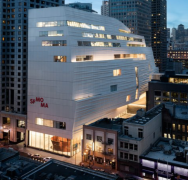
When the San Francisco Museum of Modern Art (SFMOMA) completed its massive expansion back in 2016, Time magazine’s Richard Lacayo made the bold assertion that it “transformed the City by the Bay into a premier destination for art.” After all, the extraordinary San Francisco institution had more than doubled in size and acquired the skin-like shell that is instantly recognizable today.
Here’s how to make the most of your visit:
Where Is SFMOMA?
SFMOMA is located in San Francisco's South of Market (SoMa) neighborhood, just around the corner from Yerba Buena Gardens and within easy walking distance of Union Square.
It offers a natural hub for an afternoon of museum-hopping in downtown San Francisco: The museum is flanked by several other major SoMa cultural institutions, including the Contemporary Jewish Museum and the Yerba Buena Center for the Arts. And it sits only a few blocks from the Montgomery Street BART/Muni Metro station, making it simple to reach without a car.
The museum offers two cafés and a coffee shop, as well as a museum store, so it’s easy to spend hours here with breaks to refuel.
Must-See Areas and Works of Art at SFMOMA
Start with the Living Wall on SFMOMA’s third floor, one of the largest public living walls in the country: it features roughly 19,000 plants, with 21 species native to the Bay Area. Because the wall receives only about an hour of direct light each day, its design intentionally mirrors the layered plant life found in the understory of a redwood forest, just arranged vertically.
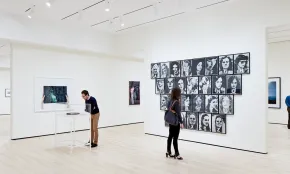
The same floor houses the Pritzker Center for Photography, the largest space in the U.S. permanently dedicated to photography. It spans 15,000 square feet and draws from SFMOMA's collection of more than 17,000 photographic works, including pieces by Ansel Adams and Dorothea Lange.
From there, head up to the fifth floor's outdoor Sculpture Terrace, where museumgoers can wander among large-scale works before taking in sweeping views back over the SoMa skyline—a nice pairing with its Cafe 5, tucked right alongside the terrace for a coffee or bite with a view.
Head down to the second floor, where you'll find many of the museum's most beloved works, drawn from its deep holdings of 20th-century modernism: Frida Kahlo's Frieda and Diego Rivera, several major canvases by Jackson Pollock and Mark Rothko, and Henri Matisse's Femme au chapeau, one of the most significant Fauvist paintings in any American collection.
Design and Architecture Highlights at SFMOMA
Any visitor here immediately notices the windows. They’re everywhere, outfitted with window boxes where you can actually sit, enjoy the light and view, and regroup before going to the next set of galleries.
The museum’s exterior panels were designed to be concrete, but that would have required a lot of steel support. So Napa County company Kreysler & Associates made each of the 700 panels out of a fiberglass-reinforced polymer. Each one is only three-sixteenths of an inch thick. Silicate crystals from Monterey County make the panels sparkle and cause the creamy white panels to naturally change color throughout the day—sometimes blue or gray in shadow, sometimes warmer in the light.
One of the most surprising aspects of the buildings is the restrooms. Each one has a different color. Stepping into brilliantly colored spaces—like raspberry or chartreuse—is like rebooting your brain after walking through so many white-box galleries.
Tours at SFMOMA
If you want to enhance your museum experience with some expert insights, SFMOMA offers several options. Daily public tours led by knowledgeable docents are free with admission and cover general highlights of the galleries, while self-guided visitors can rent audio and multimedia tours to explore at their own pace.
For a deeper dive, SFMOMA also offers private guided tours for groups of 10 or more. Tours tend to have special thematic options tied to current exhibitions—like an in-depth look at Matisse's Femme au chapeau and its influence on art history—as well as tours focused on the museum's renowned Doris and Donald Fisher Collection of postwar and contemporary art.
When Is SFMOMA Free?
Free admission at SFMOMA comes in a few different forms, from a standing weekly perk to special occasions throughout the year:
First Thursdays offer free admission to all visitors from 10 a.m. to 9 p.m. on the first Thursday of the month.
Floors 1 and 2 of SFMOMA are free to explore every day, with no admission ticket required; this includes the Koret Education Center, home to family programming, as well as rotating installations and public spaces near the museum's main entrance.
Family Free Days, held a few times a year, combine the museum’s free museum-wide admission policy for visitors 18-and-under with a dedicated family-friendly gallery tour, hands-on art activities, and storytelling sessions.
The museum also hosts periodic Free Community Days offering free admission to all visitors regardless of age, timed around current exhibitions and paired with performances and programming from local artists.
Second Sundays
On the second Sunday of every month, SFMOMA hosts Second Sundays for Families, a free program built around a different creative theme each visit. Held in the Koret Education Center on Floor 2, the day typically includes drop-in art activities, play areas. and children's books to browse—plus occasional extras like storytimes, live performances, or scavenger hunts.
Past themes have ranged from watercolor painting inspired by artist Suzanne Jackson to textile scrapbooking modeled after Pacita Abad's work. The program runs from 10 a.m. to 1 p.m. Since Floors 1 and 2 are generally free to explore, families can typically drop in without reserved tickets—though it's always worth checking SFMOMA's website beforehand, since hours and specific activities are subject to change.
SFMOMA Insider Tips
Since the museum spans seven floors, it's worth picking two or three must-see priorities rather than trying to see everything in one visit—it's easy to underestimate how much ground there is to cover.
Strollers can be borrowed from coat check on a first-come, first-served basis, which is handy for families who'd rather not lug one from the car. Be aware that wagons and metal-framed carriers are not permitted inside.
Since all tickets are timed entry, it's worth arriving about 15 minutes ahead of your slot to account for a possible line.