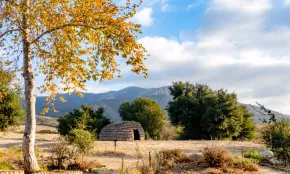
Set within a 3.5-acre park on tribal land in Santa Barbara County’s Santa Ynez Valley, the Santa Ynez Chumash Museum and Cultural Center brings Chumash history to life—embodying both the ancient ways and modern existence of this federally recognized California tribe.
In a striking blend of traditional influences and contemporary architecture, the center is fully integrated into the natural world of the Chumash. With the Santa Ynez Mountains rising in the distance, the museum is surrounded by gardens filled with the native plants that have sustained the Chumash from time immemorial.
First opened in 2025, the museum houses a permanent collection of 24,000 objects, including basketry and ceremonial regalia, engaging visitors through state-of-the-art displays, many of them interactive.
What to See Inside the Chumash Museum
Even before entering the main museum building, visitors quickly become immersed in the Chumash world.
Follow a meandering, stream-like stone path inlaid with handmade tiles commemorating thousands of years of Chumash history. Look for images of steelhead among the stones and, in a small pond along the path, actual freshwater turtles sunning themselves on rocks (the sea turtle is prominently featured on the official tribal seal).
As you approach the museum buildings, you can sense an unmistakable connection to the landscape, thanks to such design elements as the locally quarried limestone used on some walls.
What most commands your attention, however, are the two dome-like structures inspired by Chumash structures known as ‘aps. While ‘aps were traditionally constructed from willow, tule reeds, and other plant materials, the museum’s domes are covered in custom-made terra cotta tiles crafted out of Southern California clays. The tiles, in various sizes and shades, are placed in a pattern to replicate the appearance of Chumash basketry.
Once inside the museum’s Welcome House, look up and follow the curving walls to a large skylight that bathes the soaring space in a warm glow.
Dramatic paintings by artist Christopher Evans (who has done special effects work for film directors including George Lucas and Steven Spielberg) illustrate traditional Chumash dancers, while a large floor mural depicts a medicine wheel, a sacred symbol of the circle of life, healing, and the deep connections among all things in the universe. Animated images of flying golden birds projected onto the dome further add to the mystical feeling.
MORE: The Chumash Heritage National Marine Sanctuary
 Courtesy of Chumash Museum
Head down the hallway into the gallery dedicated to the museum’s permanent collection, where you’ll learn about Maria Isadora del Refugio Solares (1842–1923). Solares helped preserve the tribe’s Samala language and passed along knowledge of ancient stories and lifeways that would otherwise have been lost to time. Kathleen Marshall, museum board chairwoman, has called Solares “the matriarch of our tribe.”
Thanks to the knowledge that Solares saved for later generations, the museum offers an immersive introduction to both the physical and spiritual worlds of the Chumash. Artwork portrays daily life in historic villages—such as nearby Soxtonokmuʼ and Qsiwqsiw on Santa Rosa Island—while other installations portray the Chumash cosmology of three separate but connected worlds.
The Chumash are celebrated for their basket weaving, and a display of both historic and contemporary baskets explains their cultural significance in both daily and ceremonial life. Be sure to also check out the ceremonial regalia—such as the exquisitely crafted bear and swordfish headdresses—as well as an exhibit about California condors. The latter includes a display of the last female living in the wild before the start of the captive breeding program that saved these sacred birds from extinction.
Exploring the Cultural Park
The museum grounds, sometimes speckled with bright orange California poppies, arevery much a living expression of the Chumash world. Native coast live oak, sycamore, and walnut trees were planted here, as well as thousands of indigenous plants that the Chumash used to create their baskets and cordage.
Here you’ll have the opportunity to see a traditional tule ‘ap, as well as an authentic tomol, a modern-built version of the ocean-going redwood plank canoes that the Chumash used for trading, fishing, and hunting. Able to carry as many as 10 people and up to 30 feet long, tomols are considered one of the most advanced technological achievements of any North American tribe.
The tomol here is named Muptamai (“Deep Memories”) and was completed in 2009. It’s no museum piece, either: Muptamai makes ceremonial crossings of the Santa Barbara Channel to the island the Chumash call Limuw (Santa Cruz Island). Take time to admire the tomol’s exacting construction and craftsmanship, including such details as the craft’s abalone shell inlay.
The Story Behind the Center
When the museum and cultural center opened its doors in 2025, it was the culmination of a process that began more than 50 years beforehand, when the Santa Ynez Band of Chumash Indians first began to envision the project.
The tribe ultimately commissioned renowned architect Johnpaul Jones to bring the $32 million museum to life. Choctaw/Cherokee on his mother’s side, Jones’ deep portfolio includes the Smithsonian National Museum of the American Indian in Washington, D.C., and the Agua Caliente Cultural Museum in Palm Springs. The Chumash complex has already received its own accolades, having earned LEED Silver Certification from the U.S. Green Building Council for its environmentally sensitive architecture.
At the opening of the museum, tribal chairman Kenneth Kahn declared, “Our tribe looks forward to sharing the deep history and culture of our people with the greater community… It holds not only artifacts and exhibits but the spirit of our ancestors, the wisdom of those who came before us, and the richness of a culture that has withstood the test of time.”
MORE: Chumash Winemaker Tara Gomez
Plan Your Visit
The Santa Ynez Chumash Museum and Cultural Center is located about 30 miles from Santa Barbara, if traveling along Highway 154, and is less than 4 miles from Solvang. The museum and cultural center are open Thursdays through Sundays. Buying tickets ahead of time online is recommended to guarantee admission on your chosen date; parking onsite is free.
Insider Tips for Visiting the Chumash Cultural Museum and Cultural Center
The museum and cultural center are within walking distance of the tribally owned Chumash Casino Resort, connected by a path.
Shop for artwork, jewelry, and crafts created by Indigenous artisans at the onsite gift shop. You’ll also find tribally produced foods, including honey from California’s Yocha Dehe Wintun Nation.
On the second Thursday of each month, the museum and cultural center hosts a free open house with lectures by artists and authors.
Each October, the Chumash Intertribal Powwow features dancing, singing, and drumming as more than 300 participants from tribes across North America gather in Santa Ynez.