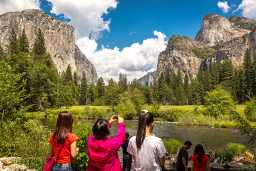
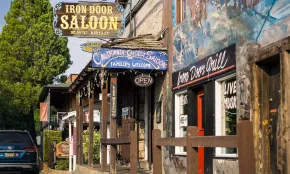
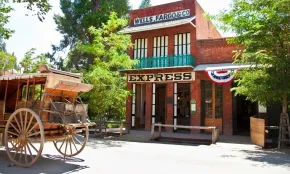
Travel back to the Gold Rush era on Highway 49, where charming mining towns dot the route, surrounded by the panoramic vistas, bubbling streams, and expansive lakes such as New Melones Lake (pictured) of the western Sierra Nevada foothills.
Where Is Highway 49?
The 300-plus mile road—also known as the Gold Rush Trail and Gold Chain Highway—begins in Oakhurst, 14 miles south of the entrance to Yosemite National Park, before heading north to a string of historic towns that have maintained their 1850s charm and eventually merging with Highway 120 near Groveland.
What Is There to See Along Highway 49?
Stop by the California State Mining and Mineral Museum in Mariposa for a quick Gold Rush history lesson, and take a gander at Hotel Jeffrey, a historic spot in Coulterville that claims John Muir and Theodore Roosevelt as past visitors.
Depending on the time of year, just north of Coulterville you can head east on Highway 120, aka Tioga Pass, into Yosemite National Park (weather permitting—check current conditions for road closure information).
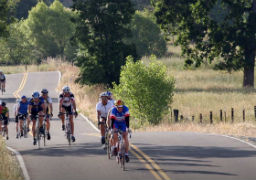
At the northern end of the highway sits Downieville, a Gold Rush boomtown founded in 1849 at the confluence of the North Yuba and Downie rivers. Once home to thousands of miners, the town today retains dozens of 19th-century wood-frame buildings, including California's only original gallows, still standing in the Sierra County Courthouse yard. Beyond its history, Downieville has become a mountain biking hub, drawing riders each summer for the legendary Downieville Classic race and festival.
MORE: Road Trip: Road to Gold
Or, if your journey continues north, you can dive deeper into Gold Rush history in Jamestown, either on board an antique steam locomotive at Jamestown’s Railtown 1897 State Historic Park or as you pan for gold.
Continue on to Sonora—a classic and well-preserved Mother Lode town known as the “Queen of the Southern Mines”—for a guided tour of the historic district. Or sip a sarsaparilla at Columbia State Historic Park, just 4 miles to the north in the town of Columbia, where tours are led by costumed docents.
Just northeast of Sierra City, there’s a spot called Loves Falls. It’s a stunning 15-foot cascade on the North Yuba River, named after an upper section where a massive, heart-shaped boulder splits the rushing water right in two. Directly underneath the falls is a deep, crystal-clear swimming hole, which is about as perfect as it gets for cooling off after a hot day on the singletrack.
The real showstopper here is the historic PCT suspension bridge that spans high above the gorge. Standing on it and watching the rapid-flowing river tear through the canyon rocks beneath your feet is worth the trip alone.
In winter, excellent locations for snow sports are nearby. Head northeast for 45 miles on Scenic Highway 4 from Angels Camp and you’ll find Bear Valley Mountain Ski Resort, as well as Lake Alpine Sno-Park, where you can cross-country ski, snowmobile, or simply build a snowman with a $5 day permit.
MORE: Sip Wine in Gold Country
Highway 49 passes through 11 counties, including Calaveras County, where a May trip would not be complete without witnessing the frog jumping contest at the Calaveras County Fair and Frog Jump Jubilee, one of the longest running events in California. To break up your drive with a thrill, descend a spiral staircase into Moaning Caverns in Angels Camp—which has a chamber big enough to hold the Statue of Liberty—or opt for the more adventurous Expedition Tour, which explores the cavern’s lower passages.
Restaurants Along Highway 49
A drive along Highway 49 is also a chance to sample some of Gold Country's best dining. In Sonora, dine on New American cuisine in a Gold Rush-era building with exposed stone walls at the Diamondback Grill. In Placerville, the restored Cary House Hotel is home to The Independent Restaurant and Bar, known for seasonal California cuisine, while nearby Smith Flat House serves refined farm-to-table fare in a historic stagecoach stop.
In Sutter Creek, Restaurant Taste offers an acclaimed menu highlighting local ingredients and regional wines. Farther north in Grass Valley, Lola at the National Exchange Hotel pairs contemporary California cooking with one of the state's oldest hotels, while Nevada City favorites include Restaurant DaKaan for globally inspired fine dining and Three Forks Bakery & Brewing Co. for wood-fired pizzas, craft beer, and house-made breads.
For more Golden State exploration ideas, continue your journey on the Road Trip Republic page.